


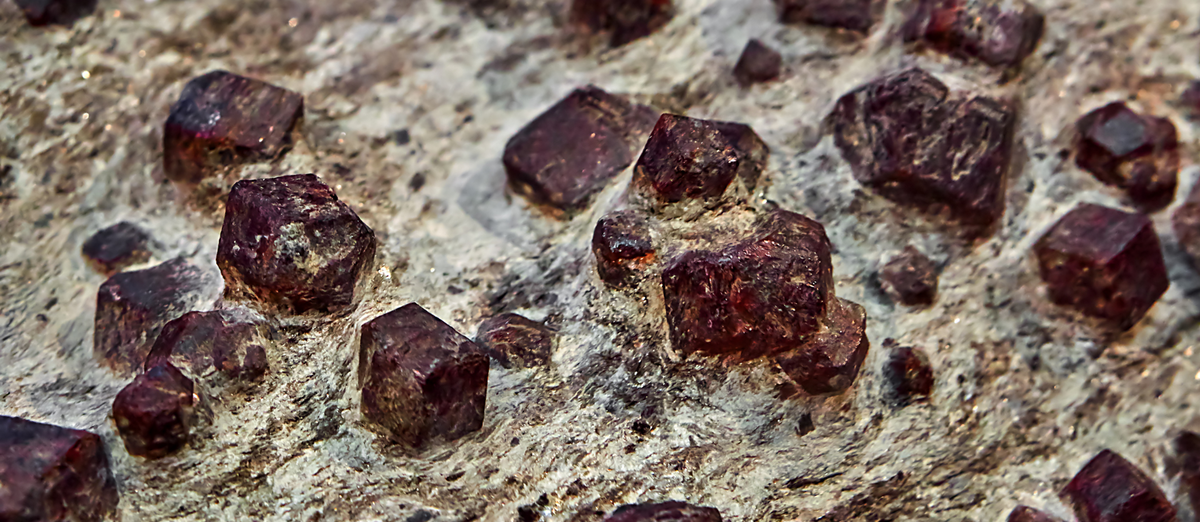
Garnets are precious stones of great beauty and versatility, known for their rich variety of colors and mystical properties. Although often associated with deep red, garnets encompass a diverse group of minerals that display shades ranging from green to orange. In this article, we explore in detail five main types of garnet: Andradite, Grossular, Spessartine, Pyrope and Uvarovite.
What Are Garnets?
Garnets are a group of silicate minerals that share a common crystalline structure but have varying chemical compositions. They are widely used in jewelry and are also valued for their metaphysical properties. The hardness of garnets ranges between 6.5 and 7.5 on the Mohs scale, making them relatively durable.
Now, let's take a closer look at the different types of garnet and their individual characteristics.
Andradite
Andradite is a garnet rich in calcium and iron, known for its high light dispersion, which surpasses even that of diamond. It occurs in various colors, including green (demantoid), yellow and black (melanite).
-
Main properties: High luminosity and brilliance.
-
Occurrence: Mainly found in Russia, Italy and Namibia.
-
Metaphysical properties: Promotes creativity, courage and emotional stability.
Grossular
Grossular is a garnet rich in calcium and aluminum, with colors ranging from light green to orange and yellow. Its translucent green variety is known as Tsavorite.
-
Main properties: High clarity and vibrant tones.
-
Occurrence: Tanzania, Kenya and Sri Lanka.
-
Metaphysical properties: Associated with prosperity, healing energy and harmonizing the heart chakra.
Spessartine
Spessartine is a manganese-rich garnet, famous for its shades ranging from intense orange to deep red.
-
Main properties: Bright colors and high transparency.
-
Occurrence: Nigeria, Madagascar and the United States.
-
Metaphysical properties: Stimulates creativity, self-confidence and enthusiasm for life.
Pyrope
Pyrope is perhaps the most classic type of garnet, with its fiery red color that gives it its name (from the Greek word for "fire"). This garnet is often used in jewelry due to its beauty and intensity.
-
Main properties: Deep red with intense brilliance.
-
Occurrence: Brazil, India and the United States.
-
Metaphysical properties: Stimulates vitality, passion and protection.
Uvarovite
Uvarovite is an extremely rare garnet, characterized by its emerald-green color. Unlike other garnets, it is rarely found in sizes large enough to be cut.
-
Main properties: Vibrant green color and crystalline structure.
-
Occurrence: Russia, Finland and Canada.
-
Metaphysical properties: Promotes serenity, spiritual growth and connection with nature.
How to Choose and Use Garnets?
-
Choose by color: Each type of garnet offers a unique energy that can be chosen based on your intention or personal preference.
-
Jewelry: Rings, earrings and necklaces with garnets are popular for their elegance and energetic properties.
-
Meditation: Use garnets to activate chakras and promote emotional balance.
Conclusion
Garnets are much more than precious stones; they are sources of energy, beauty and meaning. Whether for spiritual, decorative or collecting purposes, these minerals offer an impressive diversity of colors and properties. Explore the wonders of Andradite, Grossular, Spessartine, Pyrope and Uvarovite and discover which one resonates most with you.
Bibliographic References
-
Deer, W. A., Howie, R. A., & Zussman, J. (1992). An Introduction to the Rock-Forming Minerals. Longman.
-
Schumann, W. (2013). Gemstones of the World. Sterling Publishing.
-
Harlow, G. E. (1996). "Garnets in Nature and Their Uses." American Mineralogist, 81(5-6), 576-580.
-
Webster, R. (2000). Gems: Their Sources, Descriptions, and Identification. Butterworth-Heinemann.
-
Hall, J. (2020). The Crystal Bible. Godsfield Press.
BUY NOW →


